



Last updated June 25, 2026. This article is for education and is not medical advice; talk to your clinician about a monitoring plan that fits your situation.
Type 2 diabetes is monitored on three levels. First, a long-term blood sugar average called A1C, which your clinician checks at least twice a year. Second, day-to-day glucose readings you take at home with a fingerstick meter or a continuous glucose monitor. Third, yearly checks of your blood pressure, cholesterol, kidneys, eyes, and feet, because diabetes affects more than just blood sugar. Together these layers show whether your treatment is working and catch problems early, while they are still easy to manage.
Monitoring sounds like a lot, but most of it settles into a simple routine: a number or two at home on the days your plan calls for it, a lab test a few times a year, and a short checklist of yearly appointments. This guide walks through each layer so you know what to track, how often, and what the numbers mean. For the bigger picture, see our blood sugar monitoring guide.


Layer 1: A1C, your long-term average
The A1C test (also called HbA1c) estimates your average blood sugar over the past two to three months in a single number. It is the anchor of diabetes monitoring because it smooths out the daily ups and downs and shows the overall trend.
The American Diabetes Association recommends checking A1C at least twice a year if your blood sugar is stable and you are meeting your goals, and about every three months if your treatment has changed or you are not yet at target (ADA Standards of Care in Diabetes, 2025). A common A1C goal for many nonpregnant adults is below 7%, but targets are individualized: a younger, healthier person might aim lower, while an older adult with other health conditions may have a higher, safer target. Your clinician sets yours with you.
A1C does not replace day-to-day checks, and it can be thrown off by conditions that affect red blood cells, such as anemia. That is one reason it works best alongside the readings you take yourself. To learn what the cutoffs mean, see what a normal blood sugar level looks like.
Layer 2: Day-to-day blood sugar checks
Between lab visits, you watch your blood sugar at home. There are two main ways to do it.
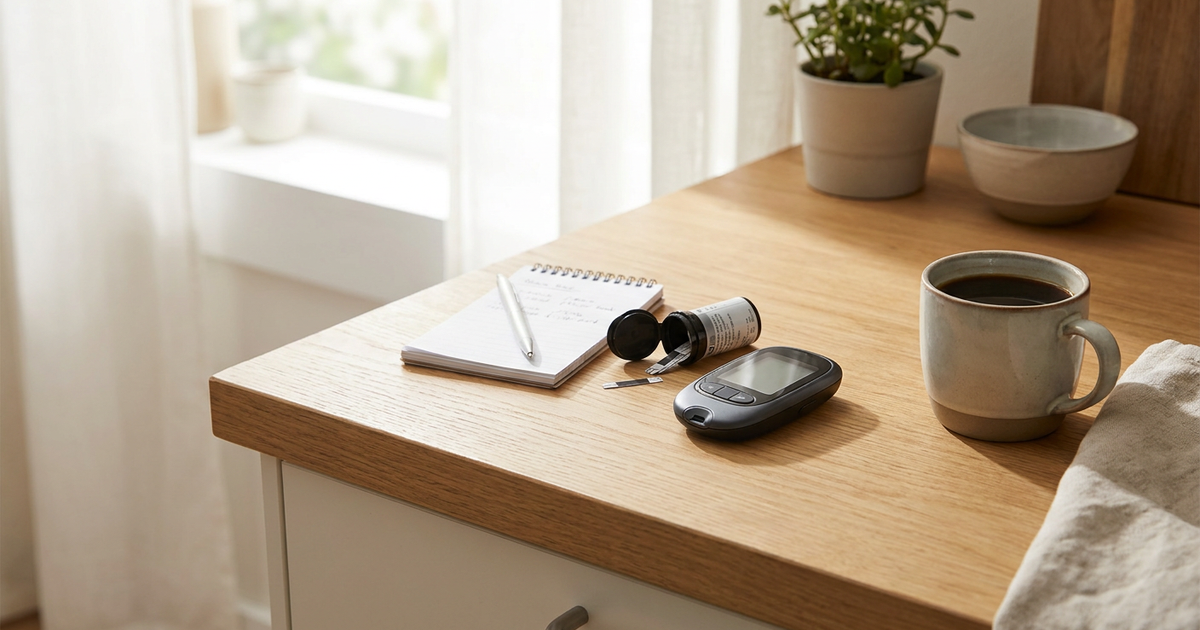
A fingerstick meter (glucometer). You place a small drop of blood on a test strip and the meter shows your glucose at that moment. How often you check depends on your treatment. People who take insulin usually test more often; many people managing type 2 diabetes with diet, lifestyle, or pills that do not cause low blood sugar may test less frequently, or mainly when something changes. Your clinician will give you a schedule. Our step-by-step walkthrough on how to use a glucometer covers the technique.
For context, the ADA lists general glucose targets for many nonpregnant adults: roughly 80 to 130 mg/dL before meals, and under 180 mg/dL one to two hours after the start of a meal (ADA, 2025). These are starting points, not rules for everyone, so confirm your own numbers with your care team.
A continuous glucose monitor (CGM). A CGM is a small sensor worn on the arm or abdomen that reads glucose every few minutes and sends it to your phone or a reader. Instead of single snapshots, it shows trends, including overnight and after meals, and many systems alert you when you are heading high or low. A useful CGM metric is “time in range,” meaning the share of the day your glucose stays between 70 and 180 mg/dL; a frequent goal is more than 70% of the time. CGMs were once mainly for people on insulin, but they are increasingly used more broadly. Our explainer on continuous glucose monitoring covers how they work and who benefits.
Layer 3: The yearly checks beyond glucose
Type 2 diabetes raises the risk of problems in the heart, kidneys, eyes, nerves, and feet, so monitoring goes beyond blood sugar. A practical way to remember the core targets is the “ABCs”: A1C, Blood pressure, and Cholesterol. Keeping all three in range does more to prevent complications than focusing on glucose alone.
Most people with type 2 diabetes should also have these checks on roughly a yearly schedule, or as their clinician advises:
- Blood pressure at most visits, with a common goal that your clinician will set for you.
- Cholesterol (a lipid panel) to gauge heart-disease risk.
- Kidney tests — a blood test for kidney function (eGFR) and a urine test for protein (albumin) — usually at least once a year.
- A dilated eye exam to catch diabetic retinopathy before it affects vision.
- A foot exam to check circulation and sensation and spot sores early.
These appointments are easy to let slip, but they are where serious complications are caught while they are still treatable. Lifestyle steps that help your daily numbers also help these checks; see our guide on how to lower blood sugar naturally.
Putting it together with your care team
It helps to think of monitoring as feedback rather than a test you pass or fail. A high reading is information, not a verdict: it tells you and your clinician that something — a meal, stress, illness, missed medication, or a treatment that needs adjusting — is worth a closer look. Patterns matter more than any single number, which is why keeping a record over time is more useful than reacting to one reading.
Monitoring only helps if the numbers reach someone who can act on them. Bring your meter, CGM summary, or a simple logbook to appointments, and ask which numbers matter most for you. A reasonable rhythm for many people is: daily or as-scheduled glucose checks at home, an A1C every three to six months, and the yearly head-to-toe checks above. If your readings are consistently high or low, or you feel unwell, that is a reason to contact your clinician rather than wait for the next visit.
Frequently asked questions
How often should type 2 diabetes be monitored?
It depends on your treatment. A1C is typically checked two to four times a year, while home glucose checks range from several times a day for people on insulin to occasional checks for those managing without blood-sugar-lowering medication. Blood pressure, cholesterol, kidney, eye, and foot checks are usually done about once a year. Your clinician tailors the schedule to you.
What are the 7 points for diabetes?
A “7-point” glucose profile is a self-testing schedule that captures seven readings in a day: before and after each of your three meals, plus one at bedtime. Done occasionally, it shows how specific meals and the overnight period affect your blood sugar, which can be more revealing than a single fasting number. It is a tool some clinicians suggest for a few days, not an everyday requirement.
What is a good A1C for type 2 diabetes?
For many nonpregnant adults, a common goal is an A1C below 7%, but the right target is individualiz

